In communities across Southern Africa, childhood can involve responsibilities and pressures that are rarely visible in the images we associate with growing up.
For some children, the day begins long before the school bell. There may be water to collect, younger siblings to help care for, or a long journey to school. At home, financial uncertainty, illness, grief or unemployment may place considerable pressure on the adults responsible for them.
These experiences are not universal, and they do not define every rural or low-income community. But for children who encounter them, they can shape far more than the practical circumstances of daily life.
They can shape how safe the world feels.
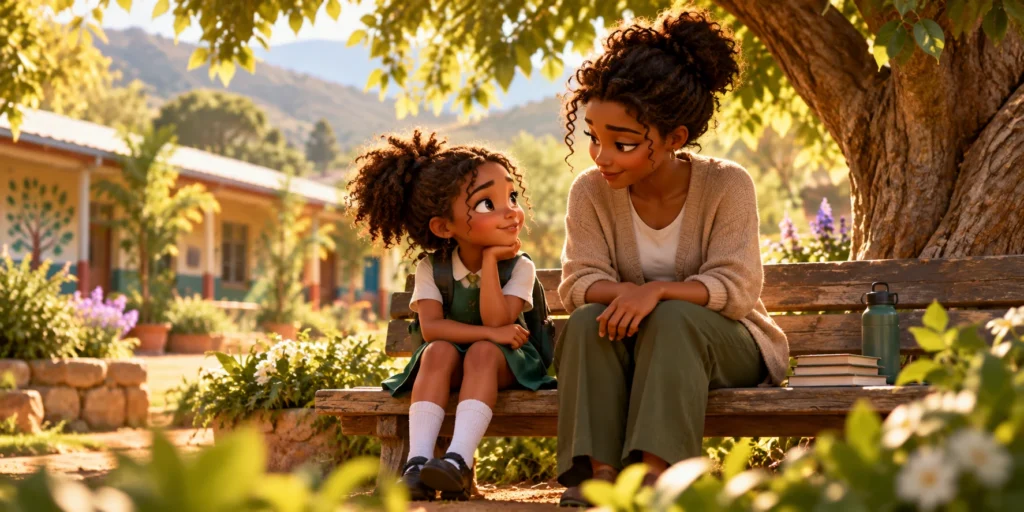
Imagine a young girl arriving at school after a difficult morning. She is quiet, attentive and careful not to cause trouble. Her teacher has many learners to support and little reason to be concerned about the child who completes her work without complaint.
On paper, she is coping.
But coping is not the same as being well.
This child is illustrative, not a documented individual case. Her story invites us to consider something easily overlooked: emotional strain is not always expressed through disruptive behaviour or visible distress.
Sometimes it looks like silence, excessive responsibility or the determination to keep going.
And when survival occupies so much of a child’s daily experience, who has the opportunity to ask what she is carrying inside?
When Childhood Carries More Than We Can See
Childhood adversity does not always arrive as one extraordinary event.
It can emerge through the accumulation of smaller, persistent pressures: uncertainty about meals, instability at home, exposure to violence, repeated loss, or the responsibility of helping a family navigate difficult circumstances.
For some children, these experiences are temporary. For others, they become part of the rhythm of everyday life.
UNICEF’s 2024 Situation Analysis of Children and Adolescents in South Africa examines how vulnerabilities across health, nutrition, education, protection and access to basic services intersect in children’s lives.
The findings remind us that a child’s wellbeing cannot be understood by looking at school performance or household income alone.
There is an emotional dimension to growing up amid uncertainty.
A child may become unusually vigilant, struggle to concentrate, withdraw from others or appear far older than their years.
Another may remain cheerful, engaged and outwardly confident while privately carrying considerable worry.
Neither response tells the complete story.
Children respond differently to hardship. Their experiences are shaped by individual circumstances, relationships, community strengths and the support available to them.
We should resist the assumption that quiet children are necessarily coping well, just as we should resist treating children who experience poverty as inherently damaged.
The question is not simply what a child has experienced.
It is also what support surrounds them as they make sense of those experiences.
A child who does not cause trouble is not necessarily a child who is free from struggle.
What Prolonged Stress Can Mean for Development
Stress is a normal part of growing up.
Children encounter disappointment, uncertainty, frustration and change as they learn to navigate the world. These experiences can become valuable opportunities for growth when appropriate support is available.
But not all stress is the same.
The Harvard Center on the Developing Child distinguishes between positive, tolerable and toxic stress responses.
When children experience significant or prolonged adversity without adequate supportive relationships, their stress response systems can remain activated in ways that may disrupt healthy development.
This can affect attention, learning, emotional regulation and longer-term physical and mental wellbeing.
The distinction matters because hardship does not produce one inevitable outcome.
A child experiencing difficult circumstances may also have deeply protective relationships with family members, teachers, neighbours or other trusted adults.
These relationships can help children understand what is happening, feel less alone and develop ways of coping.
The presence of adversity matters.
So does the presence of support.
This is why we cannot discuss children’s mental health only in terms of individual resilience.
We must also consider the conditions in which resilience is being asked to develop.
Children deserve more than the expectation that they will simply become stronger because life has been difficult.
Resilience should never become an excuse for expecting children to endure hardship without support.
The Support Gap in Under-Resourced Communities
The need for emotional and mental health support is not confined to any particular income group or geographic area.
Yet the resources available to respond can differ dramatically.
In some schools, learners may have access to counselling, educational psychologists, dedicated support teams or established wellbeing programmes.
Elsewhere, teachers and caregivers may be navigating considerable emotional needs without consistent access to specialist services.
UNICEF’s 2025 regional analysis, Protecting Children’s Mental Health in Schools, examines the state of school-based mental health and psychosocial support across Eastern and Southern Africa.
It identifies overlapping challenges involving poverty, inequality, violence, exclusion, stigma and food insecurity, alongside important gaps in the systems intended to support children.
This is not simply a question of individual teachers needing more training.
It is a question of access, coordination and sustained investment.
Schools cannot be expected to resolve the structural pressures facing families, nor should teachers be expected to act as mental health professionals.
But schools can be important places for recognising concerns, strengthening supportive relationships, building everyday capabilities and connecting children with appropriate services.
South Africa’s Department of Basic Education recognises these responsibilities within its psychosocial support approach, including support for learner and teacher wellbeing and the identification and referral of vulnerable learners.
These efforts deserve to be strengthened, not replaced by isolated initiatives.
Meaningful support should be connected to the environments and systems children already depend on.
The need for support is not determined by a school's resources. Yet too often, access to support is.
Why Support Must Begin Before Crisis
When we discuss children’s mental health, attention often turns towards visible distress.
A child begins struggling at school. Their behaviour changes. They withdraw, experience persistent anxiety or reach a point where specialist intervention becomes necessary.
Recognising these signs and ensuring access to appropriate professional care is essential.
But it should not be the only point at which we begin thinking about children’s emotional wellbeing.
Children also benefit from everyday opportunities to recognise feelings, communicate needs, practise constructive responses and develop supportive relationships.
These capabilities can be introduced in developmentally appropriate ways long before a child faces a serious mental health difficulty.
A young child learning to name frustration, a learner practising how to resolve a disagreement, or an educator helping children understand when and how to ask for help may seem like small moments.
But these moments contribute to a wider environment in which emotional understanding is treated as part of learning and growing.
The 2026 UNESCO, UNICEF and WHO guide Teaching with Care describes practical ways teachers can create supportive classrooms, promote social and emotional skills, recognise signs of distress and connect learners with further support.
This reflects an important distinction.
Preventative emotional learning and specialist mental health services are not interchangeable.
Children need access to both appropriate everyday developmental support and professional services when their circumstances require them.
Early support cannot guarantee that mental health difficulties will never arise.
Its value lies in creating more opportunities for understanding, connection and timely assistance before difficulties go unnoticed or unsupported.
Children should not have to reach a point of crisis before their emotional wellbeing becomes important.
Strengthening the Adults and Environments Around Children
A child’s development is shaped by more than any single lesson, programme or intervention.
It is influenced by the relationships and environments they encounter repeatedly.
For a young child, a trusted caregiver may provide reassurance during uncertainty. For a school learner, a teacher who notices changes in behaviour or offers consistent encouragement may become an important source of stability.
Families, schools and communities also bring valuable knowledge, relationships and strengths that should form part of any meaningful approach.
Supporting children therefore requires us to consider the adults around them.
Do educators have understandable, practical resources?
Can families reinforce learning without needing specialist knowledge?
Are adults given opportunities to build their own emotional understanding?
Do schools have appropriate pathways for identifying children who need more specialised care?
And are the resources being introduced realistic for the setting in which they will be used?
These questions matter particularly where time, finances and professional support are limited.
A programme that depends on extensive additional administration or expensive specialist materials may be difficult to sustain in a school already managing considerable demands.
Equally, a single donation of resources is unlikely to create lasting change without attention to how those resources are understood, used and reinforced.
The aim should be to build capability within existing relationships and environments, while recognising the wider services and material support that children and families need.
Children do not grow in isolation.
Neither should the responsibility for supporting them.
Meaningful support must strengthen the relationships and environments children already depend on.
Making Emotional Learning More Accessible
At the Heartwood Foundation, we believe that opportunities to develop important life capabilities should not depend solely on a family’s income or a school’s available resources.
Children need opportunities to understand their feelings, navigate relationships, respond to everyday challenges and recognise when to seek support.
These are not lessons reserved for particular classrooms or communities.
They are part of growing up.
This belief informs our work to expand access to developmentally appropriate, story-based learning and practical resources that can be reinforced by educators and families.
Our early childhood EQ Kit initiative is designed around shared stories, educator guidance and parent resources.
Our 2027 whole-school programme builds on the principle that learning should be consistent, age-appropriate and connected across the child’s environment.
Through the Foundation, we seek to make these opportunities accessible to schools and early childhood centres that may otherwise struggle to afford them.
But accessibility involves more than reducing cost.
Resources must also be relevant, understandable and practical for the adults and children using them.
We must be willing to listen to communities, recognise different circumstances and adapt responsibly rather than assuming that one approach will suit every setting.
And we must remain clear about what educational resources can and cannot do.
They can contribute to emotional understanding and everyday life skills. They cannot remove poverty, guarantee resilience or replace mental health treatment and safeguarding services.
The work is not to offer a simple solution to a complex reality.
It is to contribute something meaningful, within a broader commitment to children’s wellbeing and educational opportunity.
A child's opportunity to understand themselves and navigate life's challenges should not depend on what their school can afford.
Closing reflection
I return to the image of the quiet child in the classroom.
The child who arrives, completes her work and does not ask for much.
The child whose circumstances may be far more complicated than her school day reveals.
We cannot assume we know what she is carrying.
And we should not assume that her silence means she is unaffected.
There is immense dignity, determination and strength in communities navigating difficult circumstances. But those strengths should never become a reason to overlook the support children deserve.
The question is not whether children can survive adversity.
Many do, with remarkable courage.
The question is whether we are willing to create more opportunities for them to grow without having to carry so much alone.
Because coping is not the same as being well.
And every child deserves more than the expectation that they will simply find a way through.
Research and further reading